
# B1 V5.6: OTA repair

Use build/SikkenWorks-B1-V5.6.fwsc or B1-WebInstaller.html.
The product identity remains FM-1_481026. DSP, UI and project storage are unchanged.

If the installed B1 refuses even this update, a new package cannot repair code
already running on the device. Switch off, hold OCT-minus, then switch on to enter
the existing FM1 bootloader. Use the compatible FM1 installer for that mode.
The web installer requires a compatible USB-MIDI interface; it cannot replace
an unavailable bootloader driver. REC-at-boot is an additional silent retry mode,
but it still runs the old updater and may encounter the same validation defect.

After installing V5.6, test a V5.6 self-update first, then the desired Hub firmware.

Build: JIELI_TOOLCHAIN=/absolute/path/to/jieli python3 tools/build_v56_release.py
OTA replay: python3 tests/run_ota_v56.py
Installer validation: node tests/test_installer_v56.cjs

The 17 host simulations pass, including original V15, B1, BEETLE and RUPTURE.
This release has been flashed and tested on physical hardware.

---
Previous release documentation follows for historical reference.

<div align="center">

<img src="B1.gif" alt="B1 drawbar organ on the M-VAVE FM-1" width="240">

# B1

**A drawbar organ for the M-VAVE FM-1.**

Classic tonewheels, nine drawbars, rotary speaker, percussion and an experimental sawtooth engine, built into a pocket-sized instrument.

[The instrument](#the-instrument) &nbsp;·&nbsp; [How to use it](#how-to-use-it) &nbsp;·&nbsp; [Effects](#effects) &nbsp;·&nbsp; [Projects](#projects) &nbsp;·&nbsp; [Installation](#installation) &nbsp;·&nbsp; [Credits](#credits) &nbsp;·&nbsp; [Changelog](CHANGELOG.md)

</div>

---

## The instrument

B1 is open-source organ firmware by **SikkenWorks** for the **M-VAVE FM-1**. Rather than playing back an organ recording, it builds the sound from tonewheel-style harmonics that you mix with drawbars while you play.

B1 has two sound engines: the original **SINE / ORGAN** tonewheels and an experimental **SAWTOOTH** mode. In either engine, choose **B3 / LESLIE** for the classic organ sound or **ROCK / LORD** for a more aggressive amplifier character. Shape the result with percussion, key click, leakage, scanner chorus/vibrato, rotary speaker, delay and reverb.

| | |
| :-- | :-- |
| **Sound engines** | SINE / ORGAN and experimental band-limited SAWTOOTH |
| **Tonewheels** | 91 shared, continuously running oscillators |
| **Drawbars** | Nine harmonic drawbars per registration |
| **Organ characters** | B3 / LESLIE and ROCK / LORD |
| **Polyphony** | Up to 12 simultaneous voices |
| **Registrations** | UPPER, LOWER and SOLO |
| **Performance** | Four keyboard ranges, chords, CHORD ATTACK, 48 scales and MIDI routing |
| **Effects** | Scanner chorus/vibrato, rotary speaker, delay and reverb |
| **Memory** | 12 named, persistent projects |

## Audio stability and diagnostics

B1 uses 91 shared, phase-continuous tonewheels and up to 12 software voices. It evaluates only the wheels needed for the sounding notes, reuses common wheel samples and combines shared harmonics on steady chords. **V5.4** retains the V5.3 opt-in AUTO SAVE switch (default OFF) and optimizes the note-on contact path without changing rendered samples in native reference tests. Native OTA CHECK now accepts separately verified shorter compatible application slots and can re-use a stage previously owned by a validated Felucca-family loader; unknown flash stays protected. Stock V16 is not verified or enabled without its original package. **V5.2** retains the V5.1 SAFE/ORGAN acceleration and reuses Leslie lookup values while adding exact bounded ROCK arithmetic. V5.1 accelerated the settled SAFE/ORGAN mixer and its transient wheel prefetch using exact sine-table lookups; sound and DSP state match V5.0 bit-for-bit in native host regression tests. A linked input/output peak guard maintains digital headroom without applying a permanent compressor to every normal sample. All original organ and effect controls remain available.

For hardware timing diagnostics, open **SCL / SCALE** and press **SELECT** for **AUDIO DIAG**. Play repeated 3-, 6- and 12-note chords, and read **PEAK** (worst render time in microseconds) and **DMA MISSES** (missed buffer deadlines). Each 256-frame half-buffer has about **5,805 microseconds** at 44.1 kHz; the firmware's safety limit is 5,500 microseconds. If misses increase during chords, it is a realtime deadline problem, not necessarily digital clipping. An actual FM1 is required to establish the hardware result. B1 has been tested on physical FM1 hardware in earlier releases; the **V5.4** worst-case 12-voice timing and safe headroom are not yet hardware-certified. In a 12-voice test, aim for **zero DMA MISSES** and keep PEAK comfortably below the 5,500 µs hard deadline (ideally below 4,100 µs for roughly 25% margin).

## Firmware Hub and stock recovery status (V5.4)

B1 reports the **permanent** `FM-1_481026` application identity (not the temporary `ota-FM-1_015` or a BEETLE identity). The native updater performs CHECK against the actual incoming firmware, validates app/loader CRCs before erasing reserved OTA staging, waits for the host's eight-byte `success` confirmation, then commits. The existing strict, byte-verified original **V15** restore branch is retained; it has **not** been proven end-to-end on a physical FM1 from B1 V5.4. Original stock **V16**, `FM-1_016`, uses a different vendor firmware package and has **not** been added as an unverified full-flash bypass: its genuine package and destination layout must be independently validated before V16 recovery can be declared supported. The Hub's available stock destinations are also controlled by the Hub operator, not by this repository. **Never assume that any stock image can safely be flashed from any custom firmware.**

Earlier B1 releases have been installed and tested on a real FM1, including reports of crackling and cross-firmware failures. **The V5.5 OTA changes have not yet been physically tested**. Host protocol replays do not certify safe stock V15/V16 recovery or a two-way Firmware Hub transition. Keep an independent recovery route available and export projects before changing firmware. For vendor firmware use the official M-VAVE download and follow the vendor recovery instructions when B1's updater cannot verify it.

## How to use it

### 01 / Shape the organ with drawbars

Each drawbar controls a different harmonic. Pull it out to make that part of the sound louder; push it in to remove it. The nine drawbars follow the familiar tonewheel-organ order:

| Drawbar | Harmonic character |
| :-- | :-- |
| `16′` | Deep, one octave below the fundamental |
| `5⅓′` | Fifth above the 8′ fundamental |
| `8′` | Fundamental note |
| `4′` | One octave above |
| `2⅔′` | One octave and a fifth above |
| `2′` | Two octaves above |
| `1⅗′` | Two octaves and a major third above |
| `1⅓′` | Two octaves and a fifth above |
| `1′` | Three octaves above |

The drawbars use the usual **0–8** registration scale: `0` is silent and `8` is fully open. They respond smoothly to changes, including when notes are held.

B1 has three separate registrations: **UPPER**, **LOWER** and **SOLO**. Each has its own nine-drawbar setting. Use the organ and range pages to assign the sounds across the keyboard.

### 02 / Switch between ORGAN and SAWTOOTH

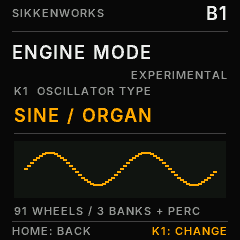
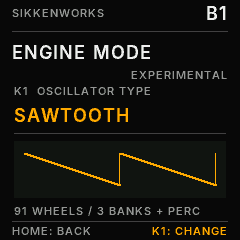
Hold **HOME + FX together** to open **ENGINE MODE**. The two buttons have a short recognition window, so you do not need to press them at precisely the same instant.

| Control | Action |
| :-- | :-- |
| **HOME + FX** | Open the ENGINE MODE screen |
| **K1 left** | Select **SINE / ORGAN** |
| **K1 right** | Select **SAWTOOTH** |
| **SEL** | Toggle between the two modes |
| **HOME** | Return to the normal drawbar screen |

**SINE / ORGAN** is B1's original organ engine. **SAWTOOTH** changes all 91 tonewheels to frequency-appropriate, band-limited saw waves: the same drawbars, registrations, keyboard assignments and effects still apply. A short crossfade makes it possible to switch while holding notes, without abruptly restarting the tonewheels.
<div align="center">

<img src="ui-captures/00-engine-mode-organ.png" alt="ENGINE MODE — SINE / ORGAN" width="192"> &nbsp; <img src="ui-captures/00b-engine-mode-saw.png" alt="ENGINE MODE — SAWTOOTH" width="192">

</div>

The selected mode belongs to the current project. A new project starts in **SINE / ORGAN**, and older projects without an engine-mode setting also open in ORGAN.

### 03 / Choose the character

**B3 / LESLIE** is the cleaner, classic organ path. Shape the sound with percussion, key click and tonewheel leakage, then add scanner chorus/vibrato and rotary-speaker movement.

**ROCK / LORD** sends the drawbar organ through a driven, asymmetric amplifier and a frequency-shaped guitar cabinet. Turn up **AMP GAIN / DRIVE**, then adjust **TONE** and **CABINET** for the speaker character. B3 / LESLIE remains available without changing projects.

Other organ controls include:

- **Percussion:** the second or third harmonic uses one shared, non-retriggering envelope for all held keys on UPPER. The third harmonic is enabled by default in new or reset projects.
- **Key click and leakage:** adjust the mechanical character of the instrument.
- **Scanner chorus/vibrato:** C/V modulation for classic organ movement.
- **Rotary speaker:** **FAST** and **ROTOR MIX 60** by default in a new or reset project, with adjustable SLOW / FAST speeds, drum-speed relationship and blend.

For a loud, classic rock-organ starting point: choose **SINE / ORGAN**, UPPER drawbars **888800000**, **ROCK / LORD**, moderately high **DRIVE** and **AMP GAIN**, and adjust **CABINET** and **TONE** to taste. Use **ROTOR MIX 0** for a stationary amplifier sound, or blend in rotary movement. Key click adds attack at lower values, while leakage gives subtle generator character. These are suggested settings, not fixed presets; the parameters remain fully editable and savable.

### 04 / Play, split and harmonize

Use the FM-1 keys or MIDI input to play B1. Its performance controls include:

- **Four keyboard ranges** for routing UPPER, LOWER, SOLO and chord selection.
- **CHORD ASSIGN ON/OFF:** on the CHORD ASSIGN page, use **K3** to enable or disable chord selector keys. With a new project, CHORD ASSIGN starts **OFF**. Turning it ON can create a selector zone at keys **21–27** when a suitable range slot is free.
- **Assign chords:** use **K2** to choose a chord quality and press a physical key in the active CHORD range to assign it; **K1** browses the physical key numbers.
- **Chord-key LEDs (V4.0):** with CHORD ASSIGN ON, every active chord selector stays steadily lit on the physical keyboard, even without holding it. Dark keys remain normal organ keys; pressing a key still lights it temporarily. This follows the actual active ranges, including overlaps, saved projects and range edits. On the **SCALE** page, the existing GUIDE takes priority so the 48-scale indication remains available. CHORD ASSIGN OFF shows normal LEDs.
- **CHORD ATTACK:** turn **K4** on the CHORD ASSIGN page (or on the active CHORD-range page) to set humanized onset timing from **0** (simultaneous) to **100** (up to roughly 65 ms, with a varied note order). To audition it, hold a chord selector key and play an ORGAN-range key.
- **48 scales**, with root-note, **KEYLOCK** and **GUIDE** options.
- **Global octave** and MIDI/range routing.

Switching CHORD ASSIGN OFF returns the keys to normal organ playing; it does **not** erase the saved chord assignments. Performance settings are part of the project, not a separate temporary preset.

### 05 / Navigate and edit

B1 uses the FM-1's screen, rotary controls and buttons. Open a parameter page, then use its labelled knobs to change the values shown on screen.

For the effects pages, **K1–K4** correspond to the parameters listed below. In the project loader, turn **K1** or **SELECT** to choose a slot and press the physical **SEL** button (second button from the left in the upper row) to load it.

## Effects

B1 combines the organ's built-in modulation with separate delay and reverb pages.

### Rotary speaker and scanner

The rotary effect provides SLOW / FAST motion, adjustable rotor speeds, drum-speed balance and a ROTOR MIX setting (60 in new projects). Scanner chorus/vibrato adds a separate modulation character. Both can be used to give sustained notes movement.

### FX 5/6 · Delay

| Control | Parameter | Range |
| :-- | :-- | :-- |
| K1 | MIX | 0–100 |
| K2 | TIME | 0–100 (approximately 32–350 ms) |
| K3 | FEEDBACK | 0–90 |
| K4 | STEREO | 0–100 |

### FX 6/6 · Reverb

| Control | Parameter | Choices / range |
| :-- | :-- | :-- |
| K1 | TYPE | OFF, SPRING, ROOM, HALL, CATHEDRAL |
| K2 | MIX | 0–100 |
| K3 | DECAY | 0–100 |
| K4 | DAMP | 0–100 |

Delay and reverb can continue to ring out briefly after you release the keys. With the effects off, a dry registration returns to silence.

## Projects

**AUTO SAVE is OFF by default.** Open **SAVE / PROJECT MENU**, then turn **K4 right for ON** or **K4 left for OFF**. The SAVE screen displays the selected setting. When ON, B1 saves live parameters after 5 seconds without changes and only after all notes/effect tails stop; background writes are wear-throttled. When OFF, B1 does not autosave changes or automatically reload the old live snapshot at power-on. Your twelve named project slots and manual SAVE/LOAD always remain available.

The ON/OFF preference is kept in the existing two-bank journal header, without changing the on-disk project format. The choice is written after 5 seconds of inactivity and a completely silent audio engine; until then SAVE displays **SETTING PENDING**. If power is disconnected before the preference finishes saving, the last committed choice applies at the next boot.


B1 stores **12 named projects** in persistent memory. A project holds the complete organ setup, including:

- All nine drawbars for UPPER, LOWER and SOLO.
- Keyboard ranges, chord assignments and chord attack.
- Scale, root, KEYLOCK, GUIDE and global octave.
- Percussion, key click, leakage, amplifier and organ bank.
- Rotary and scanner settings, delay and reverb.
- **ENGINE MODE:** SINE / ORGAN or SAWTOOTH.

To **load** a project, open the project loader, choose a slot with **K1** or **SELECT**, then press **SEL**. A successful operation shows `PROJECT LOADED` on screen. Saving uses the project's save function and confirms with `PROJECT SAVED`.

### Automatic parameter saving (V4.9)

With **AUTO SAVE ON**, B1 automatically remembers the **last live sound** separately from your twelve named projects. This includes all drawbars, three registrations, ranges and chord assignments, scale, organ/SAW engine, Leslie, percussion, amp, delay and reverb settings. The last autosaved sound is restored when B1 boots normally **only when AUTO SAVE is ON**; with AUTO SAVE OFF, startup uses its normal default scene until you manually load a project.

Autosave waits for **5 seconds after the last control edit** and for all voices and FX tails to become fully silent. Flash writes are rate-limited to **one attempt per minute** during ongoing editing to limit flash wear. No flash is written while keys are held, effects are ringing, OTA is active, or the FM1 is in REC recovery. `AUTO SAVED` briefly appears on the project page when the new snapshot is committed. Continue to use named projects for deliberate, separately stored patches.

Autosave shares B1's existing CRC-protected two-sector project journal, and uses **no new or unverified flash sectors**. If those two safe sectors are unavailable, B1 will not auto-save rather than overwrite another firmware's data. Do not switch power off immediately after editing: a pending save cannot complete until the instrument becomes silent. Older B1 project journals are read and migrated automatically on the next valid save.

Existing saved projects keep their stored settings. New or reset projects start in ORGAN, with **percussion ON (3rd harmonic)**, **rotor FAST** and **ROTOR MIX 60**. Legacy project files without an engine-mode flag select ORGAN automatically.

### Firmware identity and switching

B1 identifies itself as `FM-1_481026` on USB-MIDI and in its `.fwsc` package. This is B1's own identity and should remain unchanged in later B1 releases. It is not the BEETLE identity and is separate from the temporary OTA-loader identity used during a firmware update.

When switching to other compatible FM1 software, use a reputable Firmware Hub or WebInstaller with SHA-256 pinned source packages. A compatible loader and valid package are required; no firmware can guarantee recovery from every foreign or interrupted flash. Back up your projects and have an independent recovery path.

## Installation

The firmware is intended for the **M-VAVE FM-1**. **A valid offline-built `.fwsc` is included, but hardware boot, sound and OTA updating still require an actual FM1 test.** The repository contains a freshly compiled update package and a browser-based installer. Rebuild both together with `JIELI_TOOLCHAIN=/path/to/jieli-linux-toolchains-20250324.1 python3 tools/build_v49_release.py`.

| File / directory | Purpose |
| :-- | :-- |
| `B1-WebInstaller.html` | WebMIDI-based installer for a supported browser and compatible device |
| `build/SikkenWorks-B1-V4.9.fwsc` | B1 V4.9 native firmware (`FM-1_481026`), built with the pi32v2 compiler |
| `build/BEETLE-RC1.01-RESTORE-ORIGINAL.fwsc` | Original BEETLE reference package, included for recovery planning |
| `build/B1.elf` and `build/B1-app.bin` | Actual native pi32v2 linked ELF and flattened application image
| `firmware/` | Full C firmware source and platform integration |
| `tools/` and `tests/` | Build and verification utilities |
| `ui-captures/` | Native 240 × 240 UI captures, including ORGAN and SAWTOOTH mode screens |
| `audio-reference/` | Software-rendered audio examples |

Use **Chrome or Edge with WebMIDI** and follow the WebInstaller's device and firmware checks. The installer can validate compatible FM-1 `.fwsc` files that match B1's protected BEETLE boot-header and loader requirements. For a different firmware layout, **ENTER UBOOT** requests a handoff to the FM-1's independent update environment; the target firmware must then be installed with its own compatible installer. Neither path is a universal flasher.

**Before installing:** back up your projects and keep an independent, tested recovery method. Firmware V4.4 has passed native compilation, offline packaging and software tests, **not** a successful flash, boot or rollback on a physical FM-1. The earlier on-device `OTA FAILED -16` report has not been proven resolved by physical testing. Do not keep retrying a failed update, bypass the loader checks, or assume the included BEETLE reference is a universal recovery image.

## Credits

**B1** is developed by **SikkenWorks**.

B1 incorporates platform work from **Felucca**, developed by **Leo Kuroshita / Hügelton Instruments** and contributors. The applicable hardware abstraction, USB/OTA integration and associated files retain their original copyright notices.

B1 is released under **GPL-3.0-only**. The included Inter font is subject to its own **SIL Open Font License 1.1** (`firmware/third_party/INTER-OFL-1.1.txt`). See [`CREDITS.md`](CREDITS.md) and the accompanying license texts for the complete attribution and terms.

---

<div align="center">

**SikkenWorks** · Born out of passion.

[Version history](CHANGELOG.md)

</div>


### V5.2 performance note
Leslie and ROCK optimization preserves previous integer audio output. Full 12-voice CPU headroom on a real M-VAVE FM1 is not verified by a host benchmark; check AUDIO DIAG under worst-case conditions before claiming crackle-free operation. The permanent firmware identity remains `FM-1_481026`.
